
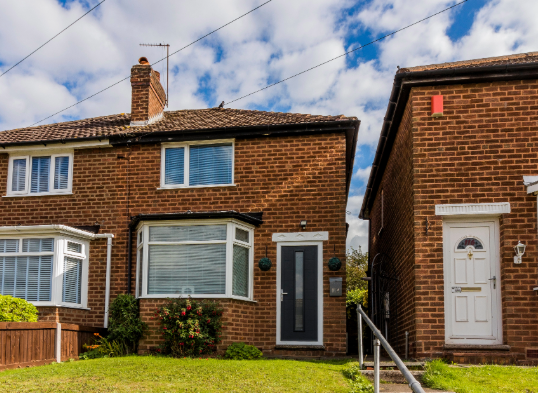
Two and three-bedroom homes are this year’s strongest sellers
Two and three-bedroom homes are this year's strongest sellers Analysis published in July 2026 based on offer data from homes listed in January of this year reveals a consistent pattern: mid-market homes are outperforming larger properties at both ends of the speed and success measure, and the gap has widened noticeably from a year earlier.

Of all homes listed in January 2026, 52% received an offer within six months. That compares with 58% of properties launched during the same period last year, reflecting a more selective buyer pool operating within a higher mortgage rate environment. The proportion attracting an offer within the first month fell from 42% to 38%.
The two and three-bedroom picture
Two-bedroom homes recorded the strongest performance of any property type in the analysis, with 55% securing an offer within six months. Three-bedroom homes followed at 53%. Both figures sit above the overall average and reflect the concentration of demand at the affordable end of the market, where buyers tend to be motivated by need rather than aspiration, and where mortgage affordability, while stretched, remains workable for a broader pool of purchasers than is the case higher up the price scale.
The contrast with larger properties is striking. Only 41% of five-bedroom homes received an offer within six months, down sharply from 59% in the equivalent period a year ago. The analysis identifies this as the clearest expression of the market’s current polarisation: affordable homes continue to perform well, while larger and more expensive properties face a meaningfully tougher environment. Higher mortgage costs have their greatest impact at higher loan amounts, and combined with wider economic uncertainty, that dynamic is causing some buyers of more expensive homes to take a more measured approach.
Freehold versus leasehold
The data also shows a clear gap between freehold and leasehold performance. Around 53% of freehold homes secured an offer within six months, compared with 48% of leasehold homes. This gap reflects the ongoing caution among buyers around leasehold complexity, service charges, and lease length concerns, particularly for flats, and is consistent with the wider finding that the strongest demand is in the mid-market house sector rather than the flat and leasehold sector.
Regional variation in the analysis
Scotland is identified as the fastest-moving market, with 68% of homes receiving an offer within six months. The East of England and Wales were the only regions to record year-on-year improvements. The South East and South West recorded some of the largest declines in the proportion of homes receiving offers within the period.
At local authority level, eight of the ten best-performing areas in the analysis were in the Midlands or the North. No London borough featured in the top ten. This geographic pattern is consistent with the broader house price data showing stronger demand in more affordable markets and softer conditions in higher-cost southern areas.
What the pricing data shows
The analysis reinforces a finding that has been consistent throughout 2026. Homes that underwent a price reduction were still 27% less likely to receive an offer than properties that remained at their original asking price. Where a price reduction did eventually lead to a sale, sellers waited an average of 49 days to receive an offer, only marginally quicker than the 53-day average recorded a year ago.
For sellers of two and three-bedroom homes, the data represents an encouraging picture, but one that remains contingent on accurate initial pricing. The strongest-performing property type in the current market is not insulated from the consequences of an overpriced launch.
Talk to our team about selling your home
This article was originally published by BriefYourMarket and is reproduced here with their permission.
For more company news and insights from Pygott & Crone, click here





Latest news

One third of properties need price reductions: How to avoid joining them
January 2026 brought a strong start to the property market.

Mortgage rates and what they mean for buyers and sellers
Mortgage rates and what they mean for buyers and sellersMortgage rates are one of the most significant factors in the UK property market, influencing how much buyers can borrow, which price brackets are accessible, and how sellers should calibrate their expectations.

What buyers are actually doing during a viewing, and why it matters
What buyers are doing during a viewing, and why it matters A viewing typically lasts thirty to forty-five minutes, and within that window a browser becomes a buyer, or does not.

Preparing for a valuation visit: What agents actually look at
Preparing for a valuation visit: What agents actually look atMost sellers tidy the house before an agent comes to value it, which is sensible enough.
